
Establish guidelines
You can establish guidelines to provide reviewers and approvers with a set of target ranges or amounts for each budget pool so that they have a starting point and reference range to work with when reviewing compensation.
Guidelines empower your reviewers and approvers with the confidence that they are reviewing compensation equitably and according to established considerations.
You can choose to prepopulate field columns with recommended increases based on the values of specific built-in or custom fields (for example, performance review rating, location, or amount of time employed) or choose to provide your reviewers and approvers with guidelines that include target values and ranges.
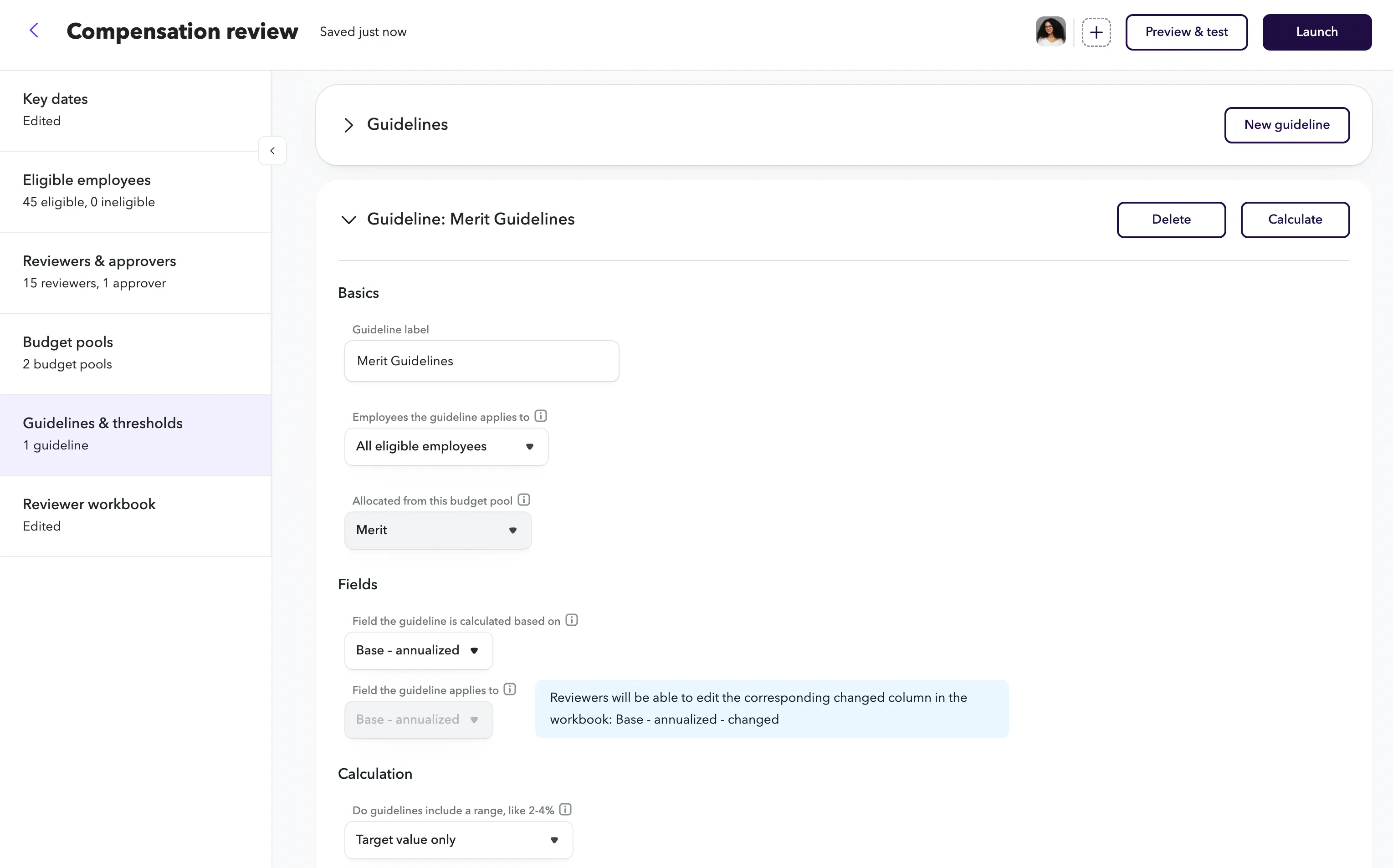
To establish guidelines, open an existing compensation review with a status of Not started or Paused. Select the Guidelines & thresholds tab.
Create a guideline
You can create and customize multiple guidelines so that you can provide as much guidance and reference points for your reviewers and approvers as you want.
To create a new guideline:
- Select New guideline. A new guideline displays with the Set amount (money) calculation at $0 USD. If your organization uses another currency, check the currency.
- Configure the guideline settings according to the parameters you want to implement. See below for a description of all fields.
- Once you are finished, select Calculate to process and update the guideline calculations. A side panel displays the calculated guideline values for each eligible employee. Guideline settings also save automatically as you make changes.
Delete a guideline
You can delete a guideline when you'd rather start over with a new configuration. Deleting a guideline doesn't affect any other guidelines you've created.
To delete a guideline:
- Find the guideline you want to delete.
- Select Delete.
- Select Confirm to delete the guideline. Confirm displays in place of Delete for a few seconds. If you don't select it, the guideline is not deleted.
Guideline settings
The following table describes the configuration fields you can apply to your guidelines:
Field | Description | Example |
|---|---|---|
Basics | | |
Guideline label | The name of your guideline. Reviewers and approvers see this label during employee compensation reviews. | Merit - US |
Employees the guideline applies to | Establishes the group or category of employees for which the guideline applies. Select from the following dropdown options: - All eligible employees - Only specific … - one option for each group type in your organization (for example, Only specific departments or Only specific locations). The options vary by organization. - Custom - a CQL filter. | Only specific locations - United States |
Allocated from this budget pool | Determines the budget pool the guideline is tied to. Choose No budget pool or any budget pool in the compensation review. When you choose a budget pool, Field the guideline applies to is set to that pool's Field budget used is calculated from field and cannot be changed. | Budget pool: Merit - US |
Fields | | |
Field the guideline is calculated based on | Determines the ChartHop field (either built-in or custom) upon which the guideline calculations are based. For example, if you choose Base, then ChartHop uses the current values of that field to perform the calculations you enter in the Calculation section. | Base |
Field the guideline applies to | Determines the ChartHop field (either built-in or custom) that is used to leverage and display the recommended guideline amount. For example, if you choose Base - changed, then ChartHop applies the calculated guideline amount to the values in the Base - changed field. Only editable fields of the same type as Field the guideline is calculated based on are listed. | Base - changed |
Calculation | | |
Do guidelines include a range, like 2-4% | Determines how your guidelines recommend compensation changes. Select from the following options: - Target value only - Indicates only a target value is recommended. - Target value + range - Indicates a target value and a range are both recommended. | Target value + range |
Are calculations dependent on one or more field values, like performance? | Determines whether the amount is calculated based on how a specific built-in or custom field is defined (for example, department, performance). Select Yes to establish additional considerations for the guideline calculations based on specific fields. Selecting Yes displays the Which field affects the calculation? field underneath. Select No, the calculation is the same for everyone to apply the calculations evenly across all eligible employees for the guideline. | Yes |
Which field affects the calculation? | Determines the built-in or custom field that affects the calculation. When you select a field, you can define how the values of this field specifically affect the guideline calculations. Eligible field types include number, money, percent, single select, scale, Yes/No, and group fields (for example, Division or Location). Select Add another field to cross the calculation by up to two more fields (Crossed by this field). The third field must be a single select, group, or Yes/No field. | Performance rating Division Business Operations 2% Customer Support 2% Sales 4% Finance 2% Legal 2% Marketing 3% Product 3% R&D 4% |
Calculation | Determines the specific calculation that is processed to affect the guideline. Select from the following dropdown options: - Percent - Set amount (money) - Custom formula - Percent - Custom formula - Set amount (money) The custom formula options are available only with Target value only, and only when calculations don't depend on a field value. For fields that are not money fields, the set amount options are Set amount (number) and Custom formula - Set amount (number). Guideline values are the recommended new value of the field, not the increase. For example, with a current base of $100,000 and a 3% target, the target displays as $103,000. A Custom formula - Percent formula returns a whole number percent (3 means 3%). A Custom formula - Set amount formula returns the new value itself. | Percent |
Minimum | Determines the minimum of the guideline range when the guideline is set to have a target value and range. This can be a percentage or a set amount depending on the Calculation used. | 2% $1500 |
Target | Determines the target of the guideline range when the guideline is set to have a target value and range. With Target value only, this field is labeled Target value. This can be a percentage or a set amount depending on the Calculation used. | 4% $3000 |
Maximum | Determines the maximum of the guideline range when the guideline is set to have a target value and range. This can be a percentage or a set amount depending on the Calculation used. Minimum and Maximum display whenever you choose Target value + range. | 6% |
Thresholds & workbook display options | | |
Flag if value deviates from guidelines | Determines whether ChartHop flags a compensation change if it deviates from the established guideline. Flagged values are highlighted in the reviewer workbook. Flags are a visual warning only and don't block reviewers or approvers from submitting. Selecting this option displays Threshold for flagging (default 5%). A value is flagged when it is further from the target than the threshold, measured as a percentage of the employee's current value of Field the guideline is calculated based on. The band is centered on the target, even when the guideline has a range. For example, with a current base of $100,000, a 3% target ($103,000), and a 5% threshold, values below $98,000 or above $108,000 are flagged. Only values that reviewers edit are flagged. | Yes |
Prepopulate editable columns with target value | Determines whether compensation reviews are prepopulated with recommended amounts for reviewers and approvers. Based on the established guideline target value. To show the guideline as a column in the reviewer workbook, select it in the workbook setup. Learn more. | Yes |
Packages: Basic | Standard* | Premium
* Available as an add-on